
Carbon Fiber Bike Damage Types: The Damage Encyclopedia
Carbon fiber is extremely strong, but damage doesn’t always show up the way it does on steel or aluminum. Serious structural issues can hide under intact paint, and some scary-looking marks can be cosmetic.
This guide explains the most common carbon fiber bike damage types, what they typically indicate, and whether repair or replacement is the safer choice. When there’s any doubt after a crash, the key is verification rather than guesswork.
What Are the Main Types of Carbon Damage?
Carbon frame damage usually falls into a few buckets: surface-level coating/resin cracking, structural fiber fractures, impact-related internal damage, crushing, delamination, and bond/interface failures. Identifying the type helps assess risk, choose a repair approach, and decide what should be verified before riding hard again.
Quick Index of Carbon Fiber Damage Types
- Surface crack: Often paint/clearcoat or resin-level cracking until proven otherwise.
- Structural crack: A fracture through carbon fibers that compromises strength.
- Impact bruise: Subsurface damage from a strike that may look minor externally.
- Crushed laminate: Compressed/buckled structure that can create a “soft” zone.
- Delamination: Internal layers separating (sometimes invisible from the outside).
- Bond failure: An interface/joint issue (often around inserts like dropouts or BB shells).
Carbon Frame Crack vs Paint Crack
This is the most common confusion: is it a cosmetic surface issue, or a structural problem underneath?
What paint/clearcoat cracking often looks like
- Spiderwebbing / crazing: fine networks of shallow cracks, often near tube junctions
- Edge flaking: chips around fittings/decals/cable stops
- Shallow-looking lines: may not expose any fibers or raw composite
What structural cracking can look like
- Cleaner fracture lines: a more distinct “break” rather than a web pattern
- A crease or kink: looks like the tube took a hard bend or hinge at one point
- Location cues: often near an impact site or a high-load area (stays, chainstays, downtube underside)
Why visuals can mislead
A deep scratch in paint can look structural, and a frame that looks fine can still have internal delamination from an impact. When you need higher confidence, ultrasound inspection for carbon frames is one of the most reliable ways to check for internal separation and voids beneath the surface and reduce uncertainty.
How We Classify Risk
Risk depends on severity and, especially, location (simple tubes vs complex interfaces).
- Low risk: often cosmetic surface issues. If it’s post-crash or near a critical area, inspection is still smart.
- Medium risk: damage that could be structural or could grow under load. Verification helps decide the next step.
- High risk: suspected structural failure, critical zones (fork/headtube/steerer/BB/dropouts), or symptoms like new creaks/handling change.
Types of Carbon Fiber Damage
Surface Crack (Paint/Clearcoat)
Surface cracks can appear as hairline fissures, spiderweb patterns, or small chips in the finish layer. These often appear superficial, especially when there’s no exposed fiber.
Paint and clearcoat are more brittle than the underlying composite. Normal flex, temperature changes, minor knocks, or local stress near fittings can crack the coating without damaging the structure.
Risk level: Usually low, but risk rises if the mark is in a high-stress zone, it appeared after a crash, it spreads quickly, or it’s accompanied by new noises or handling changes.
Common locations: Near fittings (bottle bosses, cable stops), tube junctions and edges, and areas that see clamp pressure or frequent contact.
Often, there is nothing structural underneath, but sometimes it is the visible clue of a deeper issue (impact bruise, bond issue, or localized delamination).
Typical repair approach: Confirm whether the structure is sound. If cosmetic, restoration ranges from localized finish work to full paint and clearcoat blending for an invisible result.
Read the full guide on surface cracks →
Structural Crack
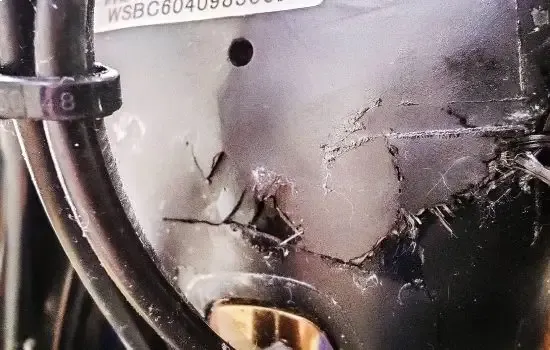
A structural crack is typically deeper and more defined, appearing to cut into the composite rather than just the finish. It may look like a clean fracture line, a jagged split, or a crease where the tube no longer looks perfectly smooth.
Most structural cracks come from meaningful trauma: a crash, a direct hit (bar swing, curb, rock), transport damage, or a crush event that breaks fibers and disrupts the laminate.
Risk level: High. Riding is risky because the load path may be compromised. Risk increases when the crack is near critical areas (headtube, bottom bracket, dropouts), when the crack is growing, or when there are symptoms like creaking or handling changes.
Common locations: Top tube (often from handlebar impacts), seat stays and chainstays (thin tubes that take side loads), and down tube (especially underside rock strikes).
Structural cracks typically indicate fractured fibers and compromised continuity through the tube. Even if the surface crack looks small, the internal damage zone can be larger.
Typical repair approach: Remove compromised material and rebuild the structure with a new laminate designed to restore continuity, stiffness, and strength. Verification after repair is what turns “looks good” into confidence.
Read the full guide on structural cracks →
Impact Bruise
An impact bruise is often subtle. It may present as a scuff, a small discoloration, a change in gloss, or a slightly dull-looking spot. Sometimes there is no obvious mark at all.
A concentrated impact transfers energy into the laminate. Common causes include rock strikes, a bike falling against a curb, a dropped tool, a bar or lever strike, or contact in a pileup.
Risk level: Medium to high. Risk rises when the impact was high-energy, when it occurred in a high-load zone, or when the area later develops symptoms like creaking, a soft spot, or handling changes.
Common locations: Underside of down tube (rock strikes), top tube (bar and lever contact), and seat stays or chainstays (side impacts).
The outside can look fine while the internal laminate has micro-fractures, resin matrix damage, or delamination. This is one of the reasons carbon damage can be easy to underestimate.
Typical repair approach: Verification is especially useful to determine whether the bruise is cosmetic or structural. If internal damage is confirmed, the typical approach is to remove the compromised area and rebuild the laminate.
Read the full guide on impact bruises →
Crushed Laminate
Crushed laminate often appears as a visibly indented, flattened, or distorted area of a tube. In some cases, the tube’s shape looks “off,” which matters because the tube’s geometry provides much of its strength.
Common causes include clamp pressure, rack incidents, overtightened hardware, or any crush event that compresses the laminate. Workstands and transport clamps are common sources when force is applied in a small area.
Risk level: High. Crushing can compromise the structure even if fibers are not cleanly severed. Risk increases with deeper deformation, proximity to high-load zones, or any sign of compromised alignment.
Common locations: Top tube (workstand or clamp pressure), down tube (transport or rack incidents), and seat tube near fittings and clamps.
Crushing can buckle layers, fracture internal plies, and trigger delamination. Even if the surface looks mostly intact, the laminate may no longer behave as a unified structure.
Typical repair approach: If repairable, the approach focuses on restoring structural integrity and the tube’s profile as closely as possible. The exact method depends on access, extent, and whether the tube’s geometry can be reliably rebuilt.
Read the full guide on crushed laminate →
Delamination
Delamination is often invisible. In more advanced cases, you may see subtle finish distortion, bubbling, or irregularities. Many delaminations do not show obvious external signs.
Impacts, repeated stress cycling, heat exposure, or manufacturing voids that become weak points over time can lead to layer separation. Certain chemical stripping processes can also damage epoxy systems and contribute to delamination.
Risk level: Medium to high. Risk rises with larger delaminated zones, delamination near critical load paths, or symptoms like new noises, soft spots, or changes in ride feel.
Common locations: Anywhere on the frame. Often around curves, transitions, and complex layups. Impact-prone zones like down tubes and stays.
Carbon frames rely on bonded layers working together. Delamination means layers have separated and can no longer share load as intended, reducing stiffness and potentially weakening the structure.
Typical repair approach: Approaches vary by severity and access. In many cases, the safest repair involves removing compromised material and rebuilding the laminate where needed, followed by verification.
Read the full guide on delamination →
Bond Failure
Signs can include persistent creaking that does not resolve with standard component service, finish cracking around inserts, or visible movement at an interface. In rare cases, an insert can partially separate.
Adhesive degradation over time, contamination, corrosion effects around metal inserts, repeated stress cycles, prior impact damage, or imperfect bonding surfaces can contribute.
Risk level: Medium to high depending on location and symptoms. Risk rises if there is visible movement, alignment concerns, or the issue is at a high-consequence interface like dropouts or bottom brackets.
Common locations: Rear dropouts, bottom bracket shells, and bonded fittings like hangers or cable stops.
A key joint that transfers load between carbon and metal (or between bonded parts) may no longer be stable. Bond failures can also indicate surrounding laminate stress or damage near the interface.
Typical repair approach: If the surrounding structure is sound, repair focuses on restoring a clean, stable bond and maintaining alignment. Verification is often appropriate when the interface is critical to safety and tracking.
Read the full guide on bond failure →
Next Steps
- If you see a crack, soft spot, new creaks, or handling feels different: stop riding.
- After a meaningful impact, consider an inspection even if the paint looks fine.
- If you’re buying used, verification can help rule out hidden damage or unknown prior repairs.
- The goal isn’t just “looks good.” It’s confidence that the structure is sound before you descend, sprint, or race.
If you want to explore professional options, start with carbon fiber bicycle repair (service overview) and the inspection pathway that fits your situation.