
Delamination in a Carbon Bike Frame
This is part of our Carbon Fiber Damage Encyclopedia, a complete guide to identifying and understanding the most common types of carbon frame damage.
Delamination means carbon layers have separated internally and are no longer working together as one structure. It can be caused by impact shock, heat exposure, manufacturing voids, or chemical damage from improper stripping or refinishing. The challenge is that carbon frame delamination can be hard to see from the outside.
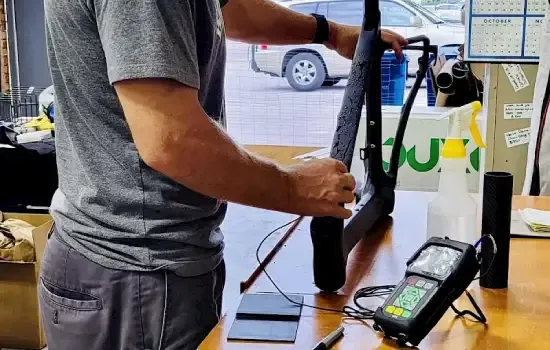
Direct answer: Delamination is internal separation between composite layers in a carbon structure. Paint can look intact even when layers underneath are compromised. Verification helps determine the extent of the issue and whether monitoring, repair, or replacement is the safest next step.
What Delamination Is
Carbon frames get strength from layers of fabric bonded together with epoxy resin. Delamination happens when those layers lose their bond and separate inside the laminate.
For a frame to be stiff and strong, layers must share load as a single unit. When they separate, load transfer becomes less efficient and stress can concentrate at the edges of the damaged zone. This is why delamination is considered a structural issue rather than a simple cosmetic blemish.
What It Looks Like
There is often no obvious external sign of a carbon delamination issue. The paint may look normal even if layers beneath have separated.
Sometimes there are subtle visual cues such as finish distortion, bubbling, rippling, or a “print-through” look where weave texture shows through the clearcoat. Changes in stiffness, new noises, or new handling concerns can be more meaningful than cosmetics. Appearance alone is not definitive.
How It Happens
Delamination can be caused by several factors that disrupt bonding between layers:
- Impact shock that separates plies without cracking paint
- Heat exposure that weakens resin systems
- Manufacturing voids that become weak points over time
- Chemical damage from aggressive stripping or incompatible refinishing processes
- Repeated stress cycling in a zone that is already compromised
Risk Level (and what raises it)
Unverified delamination is often treated as medium risk until checked. Risk becomes higher when the affected zone is large, when it is near critical load paths (headtube area, bottom bracket area, dropouts), or when symptoms appear after the event.
Risk also increases after meaningful impacts, known heat exposure, or uncertain history on a used frame.
Common Locations
Delamination can occur anywhere, but it is more common in:
- Curves, transitions, and complex layups
- Areas near junctions and stiffness changes
- Impact-prone zones like the underside of the downtube and the stays
- Areas near ports and fittings depending on how damage occurred
What It Can Mean Underneath
When bonding is lost, the frame can lose stiffness locally and stress can concentrate at the edges of the damaged zone. Under repeated load, delamination can grow. The affected area may extend beyond any visible finish clue, which is why mapping the extent matters before deciding on repair versus replacement.
Delamination vs Paint Issue vs Structural Crack
| Sign | More consistent with paint or finish issue | More consistent with delamination | More concerning for structural crack |
|---|---|---|---|
| Surface look | Crazing, shallow spiderweb lines | Often none, or subtle bubbling and rippling | Distinct crack line, crease, sharp break |
| Context | Gradual finish aging, thick clearcoat | Impact shock, heat, chemical stripping, voids | Hard impact plus fracture cues |
| Symptoms | Typically none | Sometimes new noises or changes in feel | New creaks, soft spot, handling change |
This table provides context, not certainty. Verification reduces uncertainty when safety is the priority.
What to Do Next
- After a meaningful impact, heat incident, or uncertain history on a used frame, treat it as verify-first before hard riding.
- If any stop-ride symptoms exist, do not ride the bike.
- Inspection and verification clarify the extent and help determine whether monitoring, repair, or replacement makes sense.
Typical Repair Approach
A repair plan starts by determining the extent of the delamination. If the affected zone is localized and repairable, the typical approach is to remove compromised material and rebuild the laminate in that area, then restore the finish if desired. The exact approach varies based on severity, location, and access to the damaged zone.
When Replacement Is Smarter
Replacement is often recommended when:
- Delamination is widespread across large areas of the frame
- Multiple zones show delamination or repeated delamination occurs
- Delamination involves high-consequence zones where structural certainty is difficult to achieve
- Repair cost-to-confidence is unfavorable compared to replacement
Related Resources
- Carbon Fiber Damage Encyclopedia: The complete guide to all carbon damage types
- Ultrasound inspection for carbon frames: How we verify what’s beneath the surface
- Carbon fiber bicycle repair: Our full service overview