
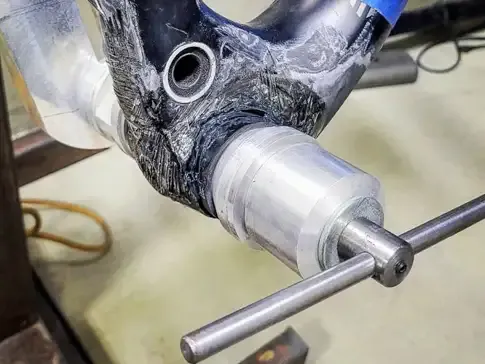
Bond Failure on a Carbon Bike Frame (Dropouts, BB, Inserts)
This is part of our Carbon Fiber Damage Encyclopedia, a complete guide to identifying and understanding the most common types of carbon frame damage.
Bond failure is when a metal insert or bonded fitting loses a secure connection to the carbon structure. It often shows up as persistent creaking, localized symptoms near one interface, or finish cracking around an insert edge. The risk is loss of alignment or poor load transfer in a high-stress zone. This guide explains what bond failure is, what it can mean, and when to verify.
Direct answer: Bond failure means a bonded interface is no longer stable. These interfaces manage critical load transfer and alignment between the frame and components. Inspection and verification help confirm the extent of the issue and determine whether repair or replacement is the safer next step.
What Bond Failure Is
A carbon frame is not only carbon. Many frames use metal inserts or bonded fittings for threaded or high-load interfaces such as dropouts, bottom brackets, and certain mounts. Bond failure occurs when the connection between the insert or fitting and the surrounding carbon becomes unstable.
Composites rely on bonded interfaces to distribute stress and maintain alignment. When an interface loosens or separates, stress can concentrate around the bond line. Over time that can contribute to surrounding laminate damage or alignment issues, especially in high-load zones.
What It Looks Like
Bond failure can be difficult to identify because symptoms overlap with normal component issues. Common signs include:
- Persistent creaks that do not improve with routine component service
- Finish cracking around the edge of an insert or fitting
- Localized symptoms that consistently seem to originate from one interface zone
Visual clues are not definitive. A professional diagnosis helps separate component noise from an interface problem.
How It Happens
Bond issues can develop for several reasons:
- Adhesive aging and repeated stress cycles over time
- Contamination or imperfect bonding surfaces during manufacturing or prior work
- Moisture exposure that contributes to corrosion effects around metal interfaces
- Impact loads from crashes or transport incidents that stress the bond line
- Prior repairs or refinishing that altered bonding surfaces or fit
Risk Level (and what raises it)
Bond failure is often treated as medium risk until verified, with higher concern for critical interfaces like dropouts, bottom bracket areas, and other high-load junctions. Risk increases when symptoms progress quickly, when the issue follows a crash or impact, or when there are visible signs around the interface such as finish cracking.
Any interface-related symptom after a meaningful impact should be treated as verify-first.
Common Locations
Bond failure is more commonly associated with:
- Rear dropouts
- Bottom bracket shells and press-fit regions
- Headset cup areas, depending on frame design
- Brake mounts and other high-load bonded fittings, depending on design
What It Can Mean Underneath
When a bond is unstable, load transfer becomes less predictable and stress can concentrate around the interface. That stress concentration can contribute to surrounding delamination or cracking over time. Bond issues can also affect alignment, which may change handling feel and tracking.
The affected zone can extend beyond the visible edge of the insert, which is why inspection focuses on the surrounding laminate as well as the interface itself.
Bond Failure vs Normal Component Creak vs Structural Crack
| Sign | More consistent with normal component noise | More consistent with bond failure | More concerning for structural crack |
|---|---|---|---|
| Symptoms | Changes with setup, service, or conditions | Persistent and localized to one interface zone | Visible fracture cues plus symptoms |
| Visual clues | Often none on the frame | Possible finish cracking near an insert edge | Distinct crack line, crease, sharp break |
| Context | Recent part change, normal wear, contamination | Long-term symptoms, impact history, interface stress | Hard impact plus fracture indicators |
This comparison provides context, not certainty. Verification reduces uncertainty when safety is the priority.
What to Do Next
- If symptoms follow a crash or involve a critical interface, treat it as verify-first.
- If any stop-ride symptoms exist, do not ride the bike.
- A qualified inspection can clarify whether this is a component issue, an interface bond issue, or deeper structural damage.
- The repair vs replacement decision depends on location, severity, and structural certainty.
Typical Repair Approach
A repair plan starts with confirming the root cause and mapping the extent of any surrounding laminate damage. If the interface is repairable, the typical approach is to restore clean bonding surfaces, re-bond using appropriate structural methods, and maintain alignment during curing. Verification after repair helps confirm the interface is stable before returning the bike to hard riding.
When Replacement Is Smarter
Replacement is often recommended when:
- There is extensive surrounding laminate damage around a critical interface
- Alignment cannot be reliably restored
- Multiple interfaces show instability or damage
- Repair cost-to-confidence is unfavorable compared to replacement
Related Resources
- Carbon Fiber Damage Encyclopedia: The complete guide to all carbon damage types
- Ultrasound inspection for carbon frames: How we verify what’s beneath the surface
- Carbon fiber bicycle repair: Our full service overview