
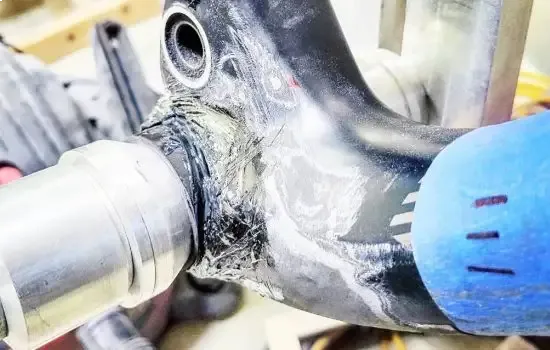
Crushed Laminate on a Carbon Bike Frame
This is part of our Carbon Fiber Damage Encyclopedia, a complete guide to identifying and understanding the most common types of carbon frame damage.
Crushed laminate is compression damage that can compromise a carbon tube’s shape and strength. It often comes from clamp pressure, racks, transport incidents, or crush-type impacts. The visible dent can understate internal damage, especially near high-load zones. This guide explains what crushed laminate is, why it matters, and when to verify.
Direct answer: Crushed laminate occurs when localized force compresses or buckles the carbon structure and deforms the tube profile. Carbon frames rely on tube geometry for stiffness and strength, so a dent or flat spot can change how loads travel through the frame. Inspection and verification help determine the extent of internal damage and whether repair or replacement is the safer choice.
What Crushed Laminate Is
Crushed laminate is compression damage where layers of carbon and resin are forced inward until they buckle. This can disrupt how the laminate shares load and can reduce strength in that zone.
Carbon behaves differently than metal when it comes to crushing forces. A metal tube might dent and still hold together. Carbon relies heavily on its designed shape and bonded layers, so changes in geometry can matter a lot.
What It Looks Like
Crushed laminate does not always present as a dramatic crack. It often looks like:
- Visible flattening, a dent, or a distorted tube profile
- Finish cracking around the dent, although paint may also look mostly normal
- A subtle “flat spot” that shows up when light reflects across the tube
Appearance is not a reliable measure of severity. Internal damage can extend beyond what the surface suggests.
How It Happens
Crushed laminate usually comes from forces the frame was not designed to handle in a small area:
- Workstand pressure, especially clamping a tube too tightly
- Transport racks or straps that apply high localized compression
- The bike falling against a hard object or being pinned in a crash
- Overtightened hardware or mounts that concentrate force in one spot
Risk Level (and what raises it)
Crushed laminate is often treated as high risk until checked. Compression can create a weakened zone that may progress under repeated riding loads.
Risk increases when the deformation is larger, when it is near junctions or interfaces (headtube area, bottom bracket area, dropouts), or when symptoms appear after the event. New noises or handling changes should be treated as urgent.
Common Locations
Crush damage is often seen in:
- Top tube (workstand clamps, transport pressure)
- Down tube (rack contact, transport incidents, pinned impacts)
- Seat tube areas near fittings and mounts
- Seat stays and chainstays if the bike is pinned or crushed in a crash
What It Can Mean Underneath
Under the dent, the laminate may include:
- Buckled plies (wrinkled or folded layers)
- Micro-buckling (small compressive failures in fibers)
- Localized delamination (layers separating and no longer sharing load well)
The internal damage zone can extend past the visible deformation. Mapping the extent is important before deciding whether repair is appropriate.
Crushed Laminate vs Impact Bruise vs Structural Crack
| Sign | More consistent with impact bruise | More consistent with crushed laminate | More concerning for structural crack |
|---|---|---|---|
| Surface look | Minor mark or none; subtle gloss change | Visible dent, flattening, distorted tube shape | Distinct crack line, crease, sharp break |
| Common cause | Concentrated strike (rock, lever) | Clamp, rack, compression, pinning force | Impact plus fracture or hinge-like damage |
| Risk driver | Hidden internal separation | Loss of tube geometry plus internal buckling | Broken fibers and disrupted load path |
This table provides context, not certainty. Verification reduces uncertainty when safety is the priority.
What to Do Next
- If a tube is visibly deformed, treat it as inspect-and-verify before hard riding.
- If any stop-ride symptoms are present, do not ride the bike.
- Inspection clarifies whether the deformation is localized and repairable, and whether other nearby areas are affected.
Typical Repair Approach
A repair plan starts by determining the extent of the crushed zone. If repairable, the typical approach is to remove compromised material and rebuild the laminate to restore structure and as much of the tube profile as practical. Cosmetic restoration can follow once the structural work is complete.
When Replacement Is Smarter
Replacement is often recommended when:
- Deformation is severe or covers a large area
- Damage is near critical interfaces where alignment and certainty are harder to achieve
- Multiple crushed areas suggest broader trauma rather than a single localized incident
Related Resources
- Carbon Fiber Damage Encyclopedia: The complete guide to all carbon damage types
- Ultrasound inspection for carbon frames: How we verify what’s beneath the surface
- Carbon fiber bicycle repair: Our full service overview