
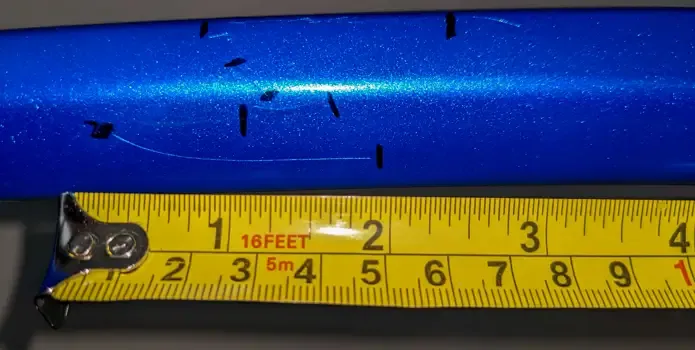
Impact Bruise on a Carbon Bike Frame
This is part of our Carbon Fiber Damage Encyclopedia, a complete guide to identifying and understanding the most common types of carbon frame damage.
An impact bruise is internal carbon damage that may look minor on the surface. It often shows up after a rock strike, tip-over, or crash contact. The risk is hidden delamination or micro-fractures beneath intact paint. This guide explains what an impact bruise is, what it can mean, and when to verify.
Direct answer: An impact bruise is subsurface laminate damage caused by a concentrated impact. The paint may look fine or show only a small scuff, while carbon layers underneath may be compromised. Verification helps determine whether the issue is cosmetic or whether the structure is affected.
What an Impact Bruise Is
Carbon fiber is strong, but it responds to sharp impacts differently than metal. A concentrated strike can damage the laminate below the surface without leaving an obvious crack in the paint.
An impact bruise can involve resin matrix micro-fractures, localized delamination, or both. The affected area may lose stiffness and strength even if the finish appears mostly intact. This is why a “small scuff” can sometimes deserve a closer look.
What It Looks Like
Hidden carbon damage can be hard to spot. Sometimes there is no clear visual sign. When there is a visible clue, it may look like:
- A small paint chip with a faint spiderweb halo
- A matte or dull spot on an otherwise glossy finish
- Slight discoloration in the clearcoat
- A small area that reflects light differently than the surrounding tube
Absence of visible damage does not confirm the frame is fine, especially after a meaningful impact.
How It Happens
Impact bruises usually come from concentrated forces such as:
- Rock strikes on the underside of the downtube
- Handlebars or brake levers contacting the top tube during a crash
- A tip-over into a curb, rock, or other hard object
- Transport knocks, including contact from another bike or a loose object
Risk Level (and what raises it)
An unverified impact bruise is often treated as medium risk until checked. Risk rises with higher energy strikes and with impacts near high-load zones like the headtube area, bottom bracket area, or near major junctions. If new creaks or handling changes appear after the event, treat the situation as urgent and stop riding.
Common Locations
Impact bruises are commonly found in:
- Underside of the downtube (road debris and rock strikes)
- Top tube near the headtube area (cockpit strike)
- Seat stays and chainstays (side impacts and crash contact)
- Around ports and fittings if the impact was nearby
What It Can Mean Underneath
Under the surface, the resin matrix may be damaged and carbon layers may separate locally. The internal damage zone can be larger than the visible mark, especially when impact energy spreads through the laminate. Mapping the extent of damage is important before deciding whether monitoring is enough or whether repair is appropriate.
Impact Bruise vs Paint Chip vs Structural Crack
| Sign | More consistent with cosmetic scuff or chip | More consistent with impact bruise | More concerning for structural crack |
|---|---|---|---|
| Surface look | Obvious paint loss, clean edge | Minor mark or none; subtle gloss change | Distinct crack line, crease, or sharp break |
| Context | Abrasion or shallow scrape | Concentrated impact (rock, lever, curb) | Hard impact plus symptoms or visible fracture |
| Symptoms | None | Often none at first | New creaks, soft spot, handling change |
This table provides context, not certainty. If safety is the priority, verification reduces uncertainty. If you see distinct crack lines or creasing, see our guide on structural cracks. For cosmetic-only damage, see surface cracks.
What to Do Next
- If the impact was meaningful, treat it as a verify-first situation before hard riding. Ultrasound inspection is one of the most reliable methods.
- If any stop-ride symptoms are present, do not ride the bike.
- An inspection can clarify whether monitoring is sufficient or whether repair is needed based on location and extent.
Typical Repair Approach
A repair plan starts by determining the extent of the damage with inspection and verification. If the issue is cosmetic only, restoration may involve localized finish work or paint blending. If internal damage is confirmed, the typical approach is to remove compromised material and rebuild the laminate in that zone, then restore the finish if desired.
When Replacement Is Smarter
Replacement is sometimes recommended when:
- There is a large internal damage zone in a critical area
- The damage is near complex interfaces where structural certainty is difficult to achieve
- Multiple bruises suggest broader trauma rather than a single localized event
Related Resources
- Carbon Fiber Damage Encyclopedia: The complete guide to all carbon damage types
- Ultrasound inspection for carbon frames: How we verify what’s beneath the surface
- Carbon fiber bicycle repair: Our full service overview